Appendix D: Memory layouts and execution patterns
Up to chapter 14 this book has treated flash-vs-SRAM as a binary choice: build the flash variant for production, the SRAM variant for emulation tests. The RP2350 hardware supports more than two patterns, and the right choice for hard-real-time code (motor control, audio DSP, anything with a strict cycle budget) is usually neither of the two defaults.
This appendix lays out the four patterns the chip can run, which ones ticktrace currently supports, and shows how to put a hot function into SRAM while leaving the rest of the program in flash.
The four patterns
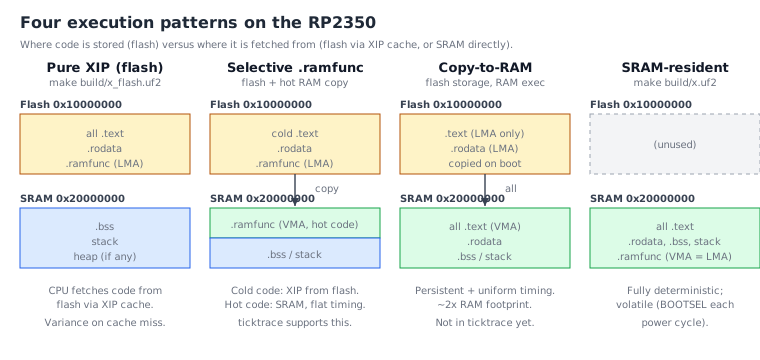
| Pattern | Code lives in | Code runs from | ticktrace support |
|---|---|---|---|
| Pure XIP (flash) | QSPI flash at 0x10000000 |
Flash, via the 16 KB XIP cache | Yes: make build/<name>_flash.uf2 |
| SRAM-resident | SRAM at 0x20000000 |
SRAM, ~1 cycle/fetch | Yes: make build/<name>.uf2 |
Selective .ramfunc |
Flash + a .ramfunc section that the startup copies to SRAM |
Cold code from flash, hot code from SRAM | Yes (used by qmi_set_clkdiv today) |
| Copy-to-RAM | Flash only | SRAM after the startup copies everything | Not yet; would need a third linker script |
The two "all-flash" and "all-SRAM" extremes are the ones we've been using. The middle two are about putting cycle-critical code in SRAM without giving up persistent flash storage.
Pattern 1: pure XIP from flash
This is what *_flash.uf2 does today. The bootrom validates the
IMAGE_DEF block at the start of flash, hands off to _reset at
0x10000000 + offset, and the CPU fetches every instruction from
QSPI flash through the on-chip XIP cache.
The XIP cache is 16 KB. On a cache hit, fetches are essentially free. On a cache miss the CPU stalls while the cache controller issues a QSPI read; tens of cycles, depending on the QSPI clock divider you configured. For most code, the cache absorbs the penalty: hot loops live in cache and run at SRAM-like speeds.
When it fails:
- The first call to a function is a cold miss.
- Working sets larger than 16 KB thrash the cache.
- ISRs that haven't run recently pay the miss cost on entry.
- Code that interleaves with other code paths in unpredictable patterns can thrash the cache.
For most application code this doesn't matter. For a 20 kHz motor control ISR it does.
Pattern 2: SRAM-resident
This is what <name>.uf2 does today. The bootrom loads the image
straight into SRAM at 0x20000000 and jumps there. Every fetch is
from SRAM, so there is no XIP variance.
Cost: the program is volatile. Lose power, lose the program. You re-flash through BOOTSEL on every power-up. For a controller you're shipping that's unacceptable; for development and benchtop work it's fine.
This is the simplest path to fully deterministic timing: nothing in your binary ever fetches from QSPI during normal operation.
Pattern 3: selective .ramfunc
This is the middle path: store the program in flash, but mark
specific functions as belonging to a .ramfunc section. At
startup, the reset handler copies those functions from flash (LMA)
to SRAM (VMA), and afterwards calls into them go to SRAM addresses.
Everything else stays in flash and runs XIP.
ticktrace already supports this. The wiring is:
link/flash.ld:45defines a.ramfuncoutput section whose load address is in flash but whose virtual address is in SRAM, plus three linker symbols:__ramfunc_load__,__ramfunc_start__,__ramfunc_end__.src/startup.S:150–160copies from the load address to the virtual address in_reset. If.ramfuncis empty the loop runs zero iterations.link/sram.ld:48–58defines the same section but with VMA == LMA (since the whole image already lives in SRAM, no copy is needed).
To put a function in SRAM on a flash build, give it its own
.ramfunc.* section:
    .section .ramfunc.my_isr, "ax"
    .thumb_func
    .global  my_isr
my_isr:
    push    {r4, lr}
    @ ...isr body, runs from SRAM, no XIP variance...
    pop     {r4, pc}
The naming convention is .ramfunc.NAME, mirroring the per-function
.text.NAME pattern (chapter 7). The linker collects all
.ramfunc.* into one block.
src/qmi.S has a real example: qmi_set_clkdiv must run from SRAM
because it reprograms the QSPI clock divider that the CPU's
instruction fetch is currently using. If it ran XIP, the CPU would
mid-flight try to fetch the next instruction with the wrong clock
config and lock up.
For motor control, the recipe is:
- Identify the cycle-critical paths: the PID ISR, the encoder read, any function on the hot loop.
- Move them to
.ramfuncsections. - Measure with DWT (Appendix C) to confirm the cycle-count variance dropped.
Pattern 4: copy-to-RAM (not yet in ticktrace)
The pico-sdk supports a PICO_COPY_TO_RAM build type that puts the
entire .text and .rodata in flash (LMA), but with VMA in SRAM
and a wholesale copy at startup. Result: persistent storage in
flash, deterministic execution in SRAM, at the cost of roughly 2×
RAM footprint (the whole program now lives in both places, though
the flash copy is read-only after boot).
ticktrace doesn't currently have this. Adding it would mean:
- A third linker script (
link/flash_copy_to_ram.ld) that places.text*and.rodata*with LMA in flash, VMA in SRAM. - A small extension to
_resetto copy the whole.text/.rodatablock before callingmain. - A new Makefile target (
*_flash_to_ram.uf2).
If you find yourself wanting this, the pico-sdk's
src/rp2_common/pico_crt0/rp2350/memmap_copy_to_ram.ld is the
canonical reference.
A worked example: cycle variance with and without .ramfunc
examples/ramfunc_demo.S defines the same busy-loop function twice:
once in default .text (lives in flash on the flash build), once in
.ramfunc.busy_ram (always lives in SRAM after startup copies it).
At runtime it calls each one many times, captures DWT cycle counts,
and prints min/max/mean over UART0:
xip   busy: min=  1004 max=  1042 mean=  1006.4
ram   busy: min=  1003 max=  1003 mean=  1003.0
(Real numbers vary by silicon, QSPI clock divider, and whether the inner loop fits in the XIP cache. The point is the variance, not the absolute count.)
On the flash variant on real hardware, you'll see the XIP path's
max exceed its min because of occasional cache misses; the
distribution has a tail. The .ramfunc path is dead-flat because
every iteration runs from SRAM. On the SRAM variant both paths are
flat (the whole image lives in SRAM).
Build and run:
$ make build/ramfunc_demo_flash.uf2
$ cp build/ramfunc_demo_flash.uf2 /media/$USER/RPI-RP2/
$ minicom -D /dev/ttyUSB0 -b 115200
The demo prints once per second after each measurement burst.
Choosing the right pattern for your workload
Use this decision tree:
Do you need persistent firmware (survives power cycle)?
├─ No   →  SRAM-resident  (make build/x.uf2)  ← simplest, fully deterministic
└─ Yes
    │
    Does anything in your code have a strict cycle budget
    (ISR latency, control-loop jitter, audio sample rate)?
    │
    ├─ No   →  Pure XIP from flash  (make build/x_flash.uf2)
    │
    └─ Yes
         │
         Is the cycle-critical code <2 KB total?
         ├─ Yes  →  .ramfunc the critical paths; rest of program in flash
         └─ No   →  consider copy-to-RAM (would need to add support
                    to ticktrace; see Pattern 4 above)
For most ticktrace users the answer is one of the first two. Motor
control, audio, software-emulated PIO state machines: those are
the cases where .ramfunc earns its keep.
What to read next
src/qmi.Sandlink/flash.ld:45: the one real.ramfuncuser in the codebase today.src/startup.S:150–160: the actual copy loop.examples/ramfunc_demo.S: the cycle-variance demo described above.- pico-sdk's
src/rp2_common/pico_crt0/rp2350/memmap_copy_to_ram.ld: the canonical reference for the full copy-to-RAM pattern, if you decide to add it to ticktrace. - Appendix C (Debugging): for the DWT mechanics used in the demo.