Chapter 12: Scheduling
Chapter 11 introduced interrupts as a way to react to single hardware events. Real firmware usually has more than one thing to do: read a UART, drive a motor, blink a status LED, service a button. Once you have more than one job, you need a story for which job runs when. That story is scheduling.
This chapter covers the two basic flavours of scheduling, names the RTOSes you'll meet in the wild, and then explains what ticktrace's scheduler does, and, just as importantly, what it does not.
Cooperative scheduling
In a cooperative scheduler, each task runs until it voluntarily yields. The runtime cannot take the CPU back.
The simplest possible cooperative scheduler is the superloop, the pattern you've already used in chapter 6:
.Lloop:
    bl      do_thing_a
    bl      do_thing_b
    bl      do_thing_c
    b       .Lloop
This works fine if every job is short and bounded. It falls apart the
moment one of them takes too long: if do_thing_b busy-waits for 50
ms, do_thing_c is starved for 50 ms too.
More sophisticated cooperative schedulers add a state machine per task and explicit yield points. Tasks "suspend" by returning, the scheduler picks the next one, runs it until it returns, and so on. This is essentially what async/await looks like on a microcontroller.
Pros: trivial to reason about, no race conditions inside a task, no preemption surprises, no per-task stacks needed (one shared stack). Cons: a misbehaving task can hold the CPU forever; latency depends on the sum of every other task's worst-case runtime.
Preemptive scheduling
In a preemptive scheduler, the runtime can interrupt a running task at any instruction and switch to a different one. The interrupted task doesn't know it happened; its registers are saved, the other task runs, eventually control returns.
Preemption is usually driven by either:
- A periodic timer interrupt, the classical "tick-based" RTOS. Every N µs the scheduler wakes up and decides who runs next.
- Event-driven preemption, an interrupt that triggers a higher-priority task immediately yanks the CPU away from a lower-priority one.
Pros: a hung task can be preempted; latency for high-priority work is bounded; you can compose tasks written by different people without auditing each other's runtimes. Cons: you need synchronisation primitives (mutexes, semaphores, queues) because two tasks can interleave at any point; each task needs its own stack; the runtime is more code and more state.
RTOSes
A real-time operating system (RTOS) is a piece of software that gives you a fully-featured preemptive (or hybrid) scheduler, plus synchronisation primitives, timers, message queues, dynamic task creation, and usually some form of memory protection. The ones you'll encounter in embedded work:
- FreeRTOS, by far the most common. C, BSD-style licence, runs on almost every microcontroller. Tick-based preemption, dynamic task creation, queues, mutexes, software timers. The pico-sdk ships an integration.
- Zephyr, newer, Linux Foundation project, much larger in scope (device tree, networking, Bluetooth). Used in increasingly serious industrial work.
- ThreadX, Microsoft (formerly Express Logic). Heavyweight, certified for medical/aviation use.
- embOS, RTX, ChibiOS, NuttX, Mbed OS, …, there are dozens.
- QV / QXK, the "Quantum Leaps" kernels by Miro Samek. QV is a cooperative-within-priority-bands kernel running on the NVIC. ticktrace's scheduler is directly inspired by QV.
An RTOS is the right answer when you need things like "spawn 5 worker threads at run time," "let this task wait on a mutex for at most 100 ms," or "queue an arbitrary-sized message between producer and consumer with deep buffering." Once you reach that complexity, build on an RTOS rather than inventing one.
But, and this is the ticktrace thesis, there is a useful regime below an RTOS where you can get most of the benefits of preemptive priority scheduling without paying the size, complexity, or indeterminism of a general kernel.
ticktrace's scheduler
src/sched.S is roughly 200 lines of assembly. It does not try to
be FreeRTOS. It implements one specific, very efficient discipline:
NVIC-priority preemptive scheduling with run-to-completion within
each priority band. This is the design Miro Samek calls the
"vanilla" kernel, abbreviated QV.
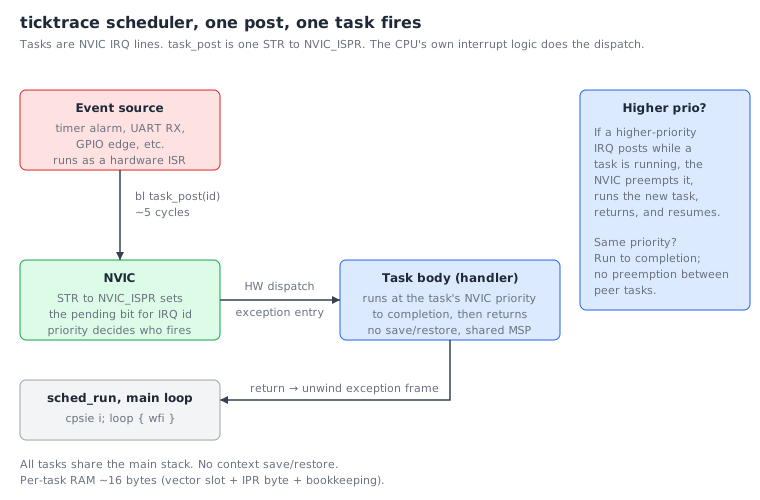
The trick is to lean on the hardware the chip already provides. The Cortex-M33's NVIC is, in effect, a tiny priority-based dispatcher built into the silicon: it knows how to take the highest-priority pending IRQ, save registers, branch to a handler, and restore on return. ticktrace just reuses it.
The mapping:
- A task is an NVIC IRQ line. Posting it is one
STRtoNVIC_ISPR(interrupt set-pending), about 5 cycles. - The CPU's exception entry runs the task body at the IRQ's priority.
- When the task returns, the exception unwinds and (if there's
nothing else pending)
wfiputs the chip back to sleep. - All tasks share the main stack. There are no per-task stacks to size or audit.
The public API
From docs/sched.md and src/sched.S:
sched_init()                          : set up NVIC pending bits, enable SEVONPEND
task_create(id, fn, prio)             : install fn as the handler for IRQ id at prio
task_post(id)                         : set NVIC_ISPR bit for id (~5 cycles)
task_post_n(mask)                     : post several tasks atomically (~6 cycles)
task_clear(id)                        : cancel a pending post via NVIC_ICPR
sched_run()                           : never returns: cpsie i; loop { wfi }
critical_enter() -> saved_primask     : disable all IRQs, return previous state
critical_exit(saved_primask)          : restore PRIMASK
critical_enter_basepri(prio) -> saved : mask IRQs below prio, allow higher to preempt
critical_exit_basepri(saved)          : restore BASEPRI
The discipline that makes this work is that every task runs to
completion unless preempted by a strictly higher-priority task.
You never block inside a task. If you want to "sleep 100 ms before
running again," you arm a TIMER alarm whose ISR calls
task_post(self) 100 ms later, and return.
What it costs
task_post: 5 cycles, single STR.task_postto task entry: 17 cycles (5 + 12 cycle hardware exception entry).- Context switch: 0 cycles, there is no save/restore, because tasks share MSP and the NVIC already does the IRQ frame for you.
- RAM per task: ~16 bytes (a vector slot, a priority byte, some
bookkeeping). Eight task slots is the default; raise
MAX_TASKSinsched.incif you need more.
For comparison, a FreeRTOS task on the same chip is at minimum a few hundred bytes of stack plus a TCB. The ticktrace model is two orders of magnitude lighter, at the cost of giving up some features.
Talking between tasks: SPSC byte queues
If a producer (often an ISR) needs to hand bytes to a consumer (a
task), use the lock-free single-producer, single-consumer byte
queue in src/spsc.S:
spsc_byte_push(queue_ptr, byte)       : ~14 cycles
spsc_byte_pop(queue_ptr)  -> r0       : ~10 cycles, -1 if empty
spsc_byte_count(queue_ptr) -> r0      : ~8 cycles
spsc_reset(queue_ptr)
Because the queue is single-producer/single-consumer and the scheduler is run-to-completion, no locks are needed at all, the hardware ordering guarantees are enough.
A 64-byte queue (declared via the M_SPSC_BYTE_QUEUE macro) holds 63
bytes (one slot reserved for the empty/full distinction).
Optional per-task cycle accounting
src/sched_stats.S gives you opt-in DWT-based profiling. Replace
task_create with task_create_traced and ticktrace wraps your task in
a 25-cycle trampoline that reads the DWT cycle counter before and
after each invocation. Then:
task_stats_total(id)        : total cycles consumed
task_stats_invocations(id)  : call count
task_stats_max(id)          : worst-case cycles in a single invocation
task_stats_reset(id)
task_stats_reset_all()
This is how you confirm that "task X took less than 2,500 cycles worst-case" before shipping a control loop.
What ticktrace's scheduler does NOT do
A direct quote from docs/sched.md, edited slightly:
- No dynamic task creation. All tasks are declared at startup. Eight slots by default. If you need 16, change a constant and rebuild.
- No task deletion at run time. Tasks live for the life of the program.
- No timers, sleeps, or delays. Use TIMER0 and the
alarm_*API if you want "fire task X at time T" or "every N µs." The scheduler does dispatch; the timer does time. - No blocking primitives. No
sleep_ms, no mutexes, no condition variables. If you need to wait on something, return and let an ISR re-post you when the event happens. - No priority inversion mitigation. Run-to-completion plus SPSC removes most of the cases where this would matter.
- No memory protection. The MPU exists on M33, but ticktrace doesn't use it.
- No watchdog kicking, power management, or partitioning. These are application concerns.
If your problem needs any of those features in a serious way, what
you want is FreeRTOS or Zephyr, not ticktrace. That is a deliberate
trade. ticktrace picks a discipline narrow enough that 200 lines of
asm and a 5-cycle task_post cover it.
When to use it
Reach for src/sched.S when:
- You have several independent jobs, each driven by a hardware event or a periodic timer.
- The jobs have an obvious priority order (a control loop should preempt a USB CDC writer; a UART receive should preempt a status LED blink).
- Each job is short and bounded, under a few thousand cycles is typical.
- You want hard latency guarantees you can prove with cycle counts.
Stick with the bare superloop from chapter 6 when there's only one job, or two trivial ones. Reach for an RTOS when you need dynamic task lifetimes, blocking synchronisation, or features ticktrace deliberately omits.
Exercises
-
Classify these requirements. For each, say which of (a) superloop, (b) ticktrace scheduler, (c) full RTOS is the cheapest tool that fits:
- A 1 Hz LED blink.
- A motor-control loop at 20 kHz with ≤ 5 µs jitter.
- A weather station that reads four I²C sensors every minute and pushes the readings to a USB host.
- A WiFi-enabled MQTT bridge that maintains TLS sessions while responding to dozens of asynchronous events.
-
Cycle math. A periodic task posts itself from a TIMER ISR every 1 ms. From the moment the TIMER fires to the moment the task body starts executing, how many cycles elapse? (TIMER ISR entry ≈ 12 + ISR body that ends with task_post ≈ 5 + exception exit ≈ 5 + new exception entry for the task ≈ 12. Order of 30–40 cycles, ~250 ns at 150 MHz.)
-
Spot the anti-pattern. What's wrong with this task body?
my_task:
    push    {lr}
    bl      uart0_puts          @ might spin for several ms
    bl      gpio_led_toggle
    pop     {pc}
(It blocks.
uart0_putsbusy-waits if the FIFO is full, holding the priority band for milliseconds. Either kick the bytes through a UART TX-empty ISR / SPSC queue, or run this task at a low priority and accept the latency.) -
Why 8 task slots? Why does the scheduler default to 8 and not, say, 64? (Each slot consumes a vector table entry and an NVIC priority byte; 8 is a sensible default for small applications. Raise
MAX_TASKSif you need more, the cost is just RAM.) -
Read the source. Open
src/sched.Sand findtask_post. Confirm it is, in fact, oneSTRplus the AAPCS prologue/epilogue.
What's next
The next chapter shows how to bring up the second CPU core and have both M33s run independent scheduling loops at the same time.
← Chapter 11: Timers and interrupts · Table of contents · Chapter 13: Multicore →