Chapter 8: Functions and the calling convention
Up to now we've been calling ticktrace driver functions without thinking too hard about how the calling works. In this chapter we make the rules explicit, so that you can write your own functions and have them play nicely with the rest of the SDK.
The set of rules we're about to learn is called AAPCS, the ARM
Architecture Procedure Call Standard. Every driver in src/ obeys
it. Every example in examples/ obeys it. If your code obeys it too,
your functions can call drivers, drivers can call your functions, and
nothing surprises anyone.
Why a calling convention exists
When function A calls function B, several questions need answers:
- Where do A's arguments go? In registers? On the stack?
- Where does B put its return value?
- Which registers can B clobber freely, and which must B preserve so that A's variables survive the call?
- Where is the return address kept?
Different conventions make different trade-offs. AAPCS is the one ARM publishes; it's what every ARM C compiler emits and what hand-written ARM assembly should follow if it wants to interoperate.
The contract in one table
| Register | Role | Caller responsible | Callee responsible |
|---|---|---|---|
r0 |
Argument 1 / return value (low) | Save before call if needed | May freely clobber |
r1 |
Argument 2 / return value (high) | Save before call if needed | May freely clobber |
r2 |
Argument 3 | Save before call if needed | May freely clobber |
r3 |
Argument 4 | Save before call if needed | May freely clobber |
r4–r11 |
General-purpose | Don't need to save | Must save/restore if used |
r12 (ip) |
Scratch | Save before call if needed | May freely clobber |
r13 (sp) |
Stack pointer | Must keep 8-byte aligned at call boundaries | |
r14 (lr) |
Return address | Must restore before returning | |
r15 (pc) |
Program counter | , |
In one sentence: r0–r3 and r12 are scratch; r4–r11 must be preserved across calls.
A call, drawn
Here's what happens when one function calls another, in time order:
sequenceDiagram
    autonumber
    participant C as caller
    participant S as stack
    participant F as callee
    Note over C: r0..r3 set up as args
    C->>S: push {r4, lr}     (save what callee may clobber)
    C->>F: bl callee         (lr ← return addr)
    F->>S: push {r4, lr}     (only if it needs r4 or makes calls)
    F->>F: work, possibly bl other_func
    F->>S: pop {r4, pc}      (restore + return)
    C->>S: pop {r4, lr} (or {r4, pc})
Two pushes, two pops, paired. Every function the SDK ships obeys this shape. If you do too, your functions compose with everything else.
Anatomy of a well-behaved function
The simplest case, a leaf function (one that doesn't call anything else):
    .section .text.add_one, "ax"
    .thumb_func
    .global  add_one
add_one:
    adds    r0, #1
    bx      lr
No push, no pop. We didn't touch r4–r11, so nothing to save. We
didn't bl anything, so lr is still our return address. bx lr
returns.
Next case, a function that uses one callee-saved register:
    .section .text.double_then_inc, "ax"
    .thumb_func
    .global  double_then_inc
double_then_inc:
    push    {r4, lr}
    mov     r4, r0          @ remember the original arg
    bl      add_one         @ r0 = r0 + 1 (clobbers r0..r3)
    adds    r0, r0, r4      @ r0 = (arg + 1) + arg
    pop     {r4, pc}
Walking through:
push {r4, lr}, Saver4(because we're about to overwrite it) andlr(becausebl add_onewill overwrite it).- We stash the input in
r4becauseblis going to clobberr0. - After the call,
r0holdsarg + 1. We add the saved arg back. pop {r4, pc}, Restorer4, and pop the savedlrdirectly intopc, which returns. This is the standard return-with-restore idiom.
Why pop {…, pc} works as a return
When you pushed lr, you saved the address you want to return to.
When you pop into pc, the CPU jumps to that address. The Cortex-M
also inspects bit 0 of the loaded pc value to decide Thumb-vs-ARM,
just like bx. Since lr always has bit 0 set in Thumb code, this
just works.
The alternative is:
    pop     {r4, lr}
    bx      lr
…which is one instruction longer for no benefit. Always use the
pop {…, pc} form.
A picture of the stack
Here's what the stack actually looks like before and after a typical prologue:
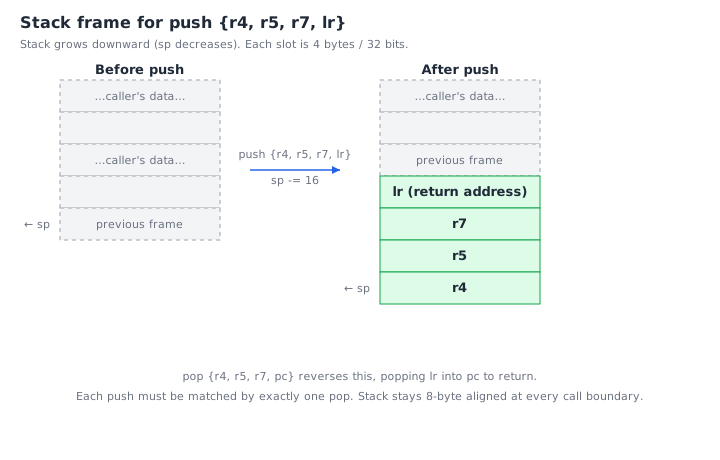
Every push must be matched by exactly one pop, or your stack drifts and the next return goes somewhere awful.
Stack alignment
AAPCS requires that sp be 8-byte aligned at every call boundary.
The stack normally grows by 4 bytes per pushed register, so:
push {r4, lr}pushes 8 bytes. Aligned.push {r4, r5, r6, lr}pushes 16 bytes. Aligned.push {r4, r5, lr}pushes 12 bytes. Not aligned.
If you push an odd number of registers, add a dummy push to keep the alignment:
    push    {r4, r5, r6, lr}    @ 16 bytes, aligned
    @ ... work ...
    pop     {r4, r5, r6, pc}
…or just pick your pushed register set so the count is even.
Passing more than 4 arguments
If a function takes more than 4 word-sized arguments, the extras go on the stack, right-to-left, with the same 8-byte alignment rule.
In ticktrace, very few functions take more than 4 arguments, so this
case rarely comes up. When it does (e.g. multicore_launch_core1
takes 3 args, so it fits), the convention is the same as in C.
Return values
- 32 bits or smaller: returned in
r0. - 33–64 bits (e.g. a uint64): returned in
r0(low) andr1(high). - Anything bigger: the caller passes a pointer in
r0and the callee writes through it. (Vanishingly rare in ticktrace.)
Interrupt handlers are different
There is one important exception: an interrupt handler is not
called by code, it's called by the hardware. The CPU itself pushes a
specific set of registers (r0–r3, r12, lr, pc, and the
PSR) onto the current stack and jumps to your handler.
Because the hardware already saved the caller-saved set, your handler
can clobber r0–r3 freely without saving them. But you still have
to save r4–r11 if you use them. And you return by branching to the
special lr value (EXC_RETURN) the hardware loaded, usually you
do this implicitly by bx lr or, more commonly, by pop {…, pc}
just like a regular function.
Chapter 11 has a worked example.
Worked example: a function that reads a pin
Let's write our own driver function. We want gpio_read(pin), return
1 if the pin reads high, 0 if low.
The hardware register we need is SIO_GPIO_IN, at address
SIO_BASE + 0x04 on the RP2350. It holds the current state of all 32
low-bank GPIO pins, one per bit.
Here it is, AAPCS-compliant:
    .include "rp2350.inc"

    .syntax unified
    .cpu    cortex-m33
    .thumb

    .section .text.gpio_read, "ax"
    .thumb_func
    .global  gpio_read
gpio_read:
    @ r0 = pin (0..31).  We assume low-bank for simplicity.
    ldr     r1, =SIO_BASE
    ldr     r1, [r1, #SIO_GPIO_IN_OFFS]     @ r1 = all 32 pin inputs
    lsrs    r1, r0                          @ shift our pin into bit 0
    movs    r0, #1
    ands    r0, r1                          @ mask to bit 0
    bx      lr
Read it:
- Loads the 32-bit GPIO input snapshot into
r1. - Shifts that snapshot right by
pinpositions, putting the bit we want into position 0. - Masks to bit 0 and returns it in
r0. - Touches only
r0andr1, both caller-saved, so no push/pop is needed andlris untouched.
You'd place this function in a file mygpio.S, assemble it alongside
the rest of ticktrace, and call it from your app:
    movs    r0, #15
    bl      gpio_read
    cbz     r0, .Lpin_low
    @ ... pin was high ...
Five instructions, one bx lr. That's a complete, AAPCS-compliant
driver function.
Reading driver source with the convention in mind
Now go open src/uart.S or src/timer.S and look at any function.
You'll see the same shape repeated:
- Optional
push {r4..., lr}if the function uses callee-saved registers or calls another function. - Argument fetch from
r0–r3. - Compute / read / write hardware.
- Optional
pop {r4..., pc}(or justbx lrfor leaf functions).
That's it. There is no other shape. Every function in ticktrace is a variation on this template.
Common mistakes
A few patterns that go wrong, with their symptoms:
- Forgetting to push
lrbefore abl. Your function will "return" to whatever was inlron entry, which is the address of its caller. The bug is silent until you observe weirdness much later. - Pushing
lrand thenbx lrinstead ofpop {…, pc}. You leak stack andbx lrjumps to the wrong place. Always pop intopc. - Clobbering
r4–r11without saving them. Your caller's local variables vanish. - Unbalanced push/pop. Stack pointer drifts. The next
popreturns to garbage.
The compiler catches none of these for you, you're writing assembly so develop the habit of reviewing every function's prologue/epilogue pair as one unit. They should always match.
Exercises
-
Push count. Which of these prologues keep the stack 8-byte aligned? (a)
push {r4, lr}(b)push {r4, r5, lr}(c)push {r4, r5, r6, lr}(d)push {r4, r5, r6, r7, lr}(a and c. b pushes 12 bytes; d pushes 20.) -
Add a prologue. Take the leaf
gpio_readexample. Modify it so it callsgpio_set_function(pin, GPIO_FUNC_SIO)first and then reads. Add the necessary push/pop, keeping AAPCS rules. -
Spot the bug. What's wrong with this function?
bad_func:
    push    {r4, lr}
    mov     r4, r0
    bl      something
    bx      lr
(It leaks the stack: it pushed
r4andlrbut doesn't pop them. Thebx lrreturns to the address that was inlrwhenbad_funcwas entered, not to the saved value, because the pushedlris still on the stack. Next caller's frame is now misaligned.) -
Why
pop {…, pc}? Why ispop {r4, pc}strictly better thanpop {r4, lr}; bx lr? (One fewer instruction, same effect, the popped value goes straight intopcand the bottom-bit-thumb-marker trick still works.) -
ISR rules. True or false: an ISR can freely clobber
r0–r3andr12without saving them. (True, the hardware saved them on the way in. Butr4–r11must still be saved if the ISR uses them. We meet this again in chapter 11.)
What's next
You now know enough to write your own driver functions and call them from your own apps. The next three chapters apply this to real peripherals: GPIO in chapter 9, UART in chapter 10, and timers with interrupts in chapter 11.
← Chapter 7: Assembler syntax and instructions · Table of contents · Chapter 9: GPIO and memory-mapped I/O →