Chapter 13: Multicore
The RP2350 has two Cortex-M33 cores on the same die. They share SRAM, peripherals, and the SIO block; each has its own register file, NVIC, and SysTick. Up to chapter 12 we have used core 0 exclusively and let core 1 sit in its reset state, idle. This chapter brings the second core up and uses both.
A second core is not free real estate. It is a real processor that runs concurrently with the first, and concurrency means synchronisation. We'll cover the launch handshake, the three primitives ticktrace gives you for inter-core coordination (FIFO mailbox, hardware spinlocks, interpolators), the canonical Larson-pattern from the example tree, and the things ticktrace pointedly does not offer.
What "two cores" buys you
In practice, dual core is useful when you have two workloads with different latency requirements that don't fight over the same hardware:
- Hot loop on one core, housekeeping on the other. Motor-control PID on core 0; USB CDC logging on core 1.
- Real-time on one core, anything-goes on the other. Time-sensitive PWM on core 0; UI / network on core 1.
- Pipelined data flow. Core 0 samples ADC + does FIR; core 1 consumes the filtered stream and ships it over USB.
What it does not buy you: a faster single thread, automatic
parallelism of existing single-core code, or transparent load
balancing. There is no kernel, no scheduler across cores. Each core
runs its own main, with its own stack, its own vector table, and
its own ideas about what the world looks like.
Launching core 1
When the chip boots, only core 0 runs your firmware. Core 1 sits in
its bootrom waiting for a wake-up sequence over the SIO FIFO,
the inter-core mailbox at SIO_BASE + 0x050..0x058.
The wake-up sequence, from src/multicore.S:12-16, is six 32-bit
words sent in a strict order, each echoed back by core 1 before the
next is sent:
0, 0, 1, vtable, sp, entry
If any echo doesn't match, the protocol restarts from the first 0.
The vtable is core 1's vector table base (128-byte aligned), sp
is its initial stack pointer, and entry is the address core 1
should jump to once the handshake completes. All three are arguments
the user supplies.
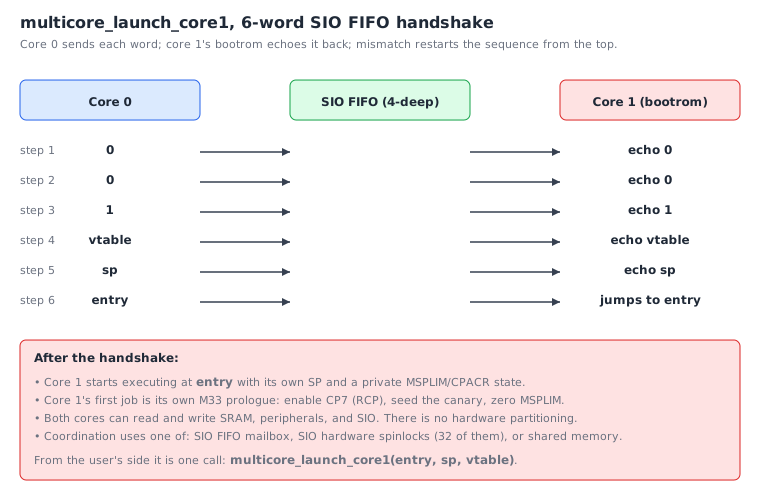
You don't write this by hand. ticktrace wraps it as a single call:
    ldr     r0, =core1_entry        @ where core 1 starts
    ldr     r1, =_core1_stack_top   @ its stack
    ldr     r2, =_ram_vectors       @ its vector table
    bl      multicore_launch_core1  @ returns once core 1 has started
multicore_launch_core1 (src/multicore.S:131) builds the command
array on the stack, sends it, and retries on mismatch. When it
returns, core 1 is about to execute the first instruction at entry.
Core 1's prologue
Each M33 core has its own banked CPACR (which controls FPU/RCP
access) and MSPLIM (stack limit). Core 0's _reset in
src/startup.S sets these up only for itself. Core 1's entry
function therefore has to repeat the prologue for its own copy:
core1_entry:
    @ Enable CP7 (RCP) on core 1's CPACR
    ldr     r0, =0xE000ED88
    movs    r1, #0xC0
    lsls    r1, r1, #8
    str     r1, [r0]

    @ Seed RCP canary (idempotent : guarded against double init)
    @ ... see examples/multicore_usb_demo.S:90-105 ...

    @ Zero MSPLIM so pushes don't fault
    movs    r0, #0
    msr     msplim, r0

    @ Now we are a real M33 core. Do whatever we are here for.
    bl      do_core1_work
examples/multicore_usb_demo.S:90-105 has the canonical prologue;
copy it into your own core1_entry. After it, core 1 can use the
FPU, push to its own stack, and call any ticktrace driver.
Coordinating: the three primitives
Once both cores are running, they share SRAM and every peripheral register. They do not share registers, stacks, or vector tables. ticktrace gives you three primitives for getting them to cooperate.
SIO FIFO mailbox
The same FIFO used for launch is also a general-purpose 4-deep word mailbox in each direction. Each core can push a 32-bit word and the other can pop it.
multicore_fifo_drain()                : empty the inbound FIFO
multicore_fifo_push_blocking(word)    : spin on RDY, write, SEV
multicore_fifo_pop_blocking() -> r0   : spin on VLD (with wfe), read
Use it when one core wants to hand the other a small piece of news: a counter snapshot, a "go" signal, a single sample. It's too shallow to be a real queue, for bulk data, put a ring buffer in SRAM and use the FIFO just for the "wake up, there is something for you" notification.
Hardware spinlocks
The RP2350 has 32 hardware spinlocks at SIO_BASE + 0x100 + n*4.
The protocol is the simplest possible: reading the address returns
non-zero if you got the lock and 0 if someone else has it; any write
releases it.
spin_try_lock(idx)      -> r0   : 0 = busy, non-zero = acquired
spin_lock_blocking(idx)         : busy-wait until acquired
spin_unlock(idx)                : release
Use a spinlock when both cores will mutate the same data structure. Hold it for as few cycles as possible, these are busy-wait locks, not blocking ones; while one core holds the lock, the other burns power spinning.
Convention: pick a spinlock number for each shared resource and use
it consistently. examples/multicore_full_usb_demo.S uses spinlock 0
for a shared counter that both cores touch.
Interpolator units
Each core has two interpolators (INTERP0 at SIO + 0x80,
INTERP1 at SIO + 0xC0). They are tiny per-core hardware blocks that
do shift-mask-add in a single cycle:
result = ((ACCUMx >> SHIFT) & mask) + BASEy
They aren't really a multicore primitive, they're per-core hardware but they show up in multicore examples because each core has its own pair and they're useful for the kind of tight fixed-point work people do inside a core 1 hot loop.
interp_set_accum(idx, lane, value)
interp_set_base (idx, lane, value)
interp_set_ctrl (idx, lane, ctrl_word)
interp_peek (idx, which) -> result   : read without advancing
interp_pop  (idx, which) -> result   : read and advance accumulators
The classical use case is texture mapping, table lookup with
interpolation, or fast index generation in a DSP loop. See
docs/sched.md references and the second multicore example for a
worked use.
The canonical pattern
Read examples/multicore_usb_demo.S and
examples/multicore_full_usb_demo.S, they're the templates.
A simplified shape:
    @ ============================================================
    @ Core 0 : owns USB, prints heartbeat
    @ ============================================================
main:
    bl      xosc_init
    bl      pll_sys_150_mhz
    bl      pll_usb_48_mhz
    bl      clocks_init
    bl      tick_init
    bl      usb_cdc_init

    ldr     r0, =core1_entry
    ldr     r1, =_core1_stack_top
    ldr     r2, =_ram_vectors
    bl      multicore_launch_core1

.Lloop_c0:
    ldr     r0, =msg
    bl      cdc_puts
    bl      delay_1s
    b       .Lloop_c0

    @ ============================================================
    @ Core 1 : owns the LED
    @ ============================================================
core1_entry:
    @ ... CPACR + RCP + MSPLIM prologue ...
    bl      gpio_led_init
.Lloop_c1:
    bl      gpio_led_toggle
    bl      delay_500ms
    b       .Lloop_c1
Two independent main loops, sharing only the GPIO/SIO hardware. No locks needed, they touch disjoint pins. The pattern scales: if both cores want to read or write the same shared variable, wrap the access in a spinlock; if one core wants to notify the other, send through the FIFO.
What multicore in ticktrace does NOT do
A short, honest list:
- No inter-core scheduling. Each core runs its own scheduler (or superloop). There is no task migration. A task posted on core 0's NVIC fires on core 0 only.
- No transparent shared data structures. No "lock-free queue spanning cores" library. Build what you need from SRAM, spinlocks, and the FIFO.
- No blocking inter-core wait.
spin_lock_blockingbusy-waits; it does not put the core to sleep. If you want a sleep-and-wake pattern, the inbound FIFO already supports it (the popper sits inwfe). - No core teardown. Once core 1 is launched, you can't kill it cleanly from core 0. You can spin it on a flag if you want it idle.
- No NUMA tricks. SRAM is uniform-access from both cores. There is no per-core fast SRAM region exposed in ticktrace beyond what the bootrom defines.
If you need an SMP-style scheduler with task migration, look at FreeRTOS SMP or Zephyr's SMP build. ticktrace stops where the hardware stops being simple.
Exercises
-
Whose job? For each task below, decide whether to run it on core 0, core 1, or doesn't matter:
- A 20 kHz PID loop driving a brushed motor.
- A USB CDC log writer that prints debug strings.
- A SysTick-driven status LED.
- Reading an SD card over SPI to load a config file at startup.
-
Lock or no lock? Two cores both increment a shared
uint32_tcounter. Does this need a spinlock on the RP2350? (Yes, the read-modify-write is not atomic across cores even though a single STR is. Wrap the increment inspin_lock_blocking(0)/spin_unlock(0).) -
FIFO depth. The SIO FIFO holds 4 words. If core 0 pushes 5 words back-to-back and core 1 isn't reading, what happens to the 5th push? (It blocks,
multicore_fifo_push_blockingspins on the RDY flag until there's room.) -
Why does core 1 need its own prologue? Why doesn't core 0's
_resetcover core 1 as well? (CPACR and MSPLIM are banked per-core. Whatever core 0 writes to them affects core 0 only. Core 1 starts in its reset state for those registers, so its entry function must repeat the prologue.) -
Read the example. Open
examples/multicore_full_usb_demo.S. Identify (a) where core 1 is launched, (b) what spinlock number protects the shared counter, (c) what core 0 reads from the FIFO, and (d) how the interpolator on each core is used.
What's next
The final chapter maps the remaining
peripherals in src/, DMA, PIO, the C and Rust bridges, and gives
you project ideas to build on top of everything we've covered.
← Chapter 12: Scheduling · Table of contents · Chapter 14: Where to go next →