USB device controller (M4-H)
src/usb.S is the ticktrace USB device-mode driver, plus a minimal CDC-ACM
class layer. Plug a Pico 2 running usb_cdc_echo_demo.uf2 into a host and
/dev/ttyACM0 will appear; bytes you send round-trip back as echoes.
This document describes the controller architecture, the DPRAM layout, the SETUP-handler state machine, the CDC-ACM descriptor walkthrough, and what to test when you flash a real Pico 2.
Controller architecture
The RP2350 USB controller is a full-speed (12 Mbps) USB 2.0 IP block with a built-in PHY. It exposes two memory windows:
| Base | Size | Contents |
|---|---|---|
0x50100000 |
4 KiB | DPRAM: packet buffers + per-EP control |
0x50110000 |
4 KiB | controller registers (CTRL/STATUS/INT) |
Bring-up order, all in usb_device_init:
- Clear
RESETS_RESET[28](bitusbctrl) via the+0x3000atomic CLR alias. Spin onRESET_DONE[28]. - Zero the entire 4 KiB DPRAM so EP control + buffer-control words start in a known state.
USB_MUXING = TO_PHY | SOFTCON: route the controller to the internal PHY and let firmware control connect/disconnect.USB_PWR = VBUS_DETECT | VBUS_DETECT_OVERRIDE_EN: the Pico 2 doesn't have a VBUS sense pin, so we pretend it's always asserted.MAIN_CTRL = CTRL_EN(device mode;HOST_NDEVICE = 0).SIE_CTRL = PULLUP_EN | EP0_INT_1BUF: signal the device's presence on the bus and enable EP0 buffer-completion interrupts.INTE = SETUP_REQ | BUFF_STATUS | BUS_RESET: only the three IRQ lines we care about.
After step 7 the host sees the device on the bus and starts enumerating.
DPRAM layout
0x000  setup_packet[8]              SETUP request (host -> device)
0x008  ep_ctrl[1..15] in/out        15 pairs * 8 = 120 B
                                    offset = 0x08 + 8*(n-1)
                                    EP0 has no ep_ctrl entry (implicit).
0x080  ep_buf_ctrl[0..15] in/out    16 pairs * 8 = 128 B
                                    offset = 0x80 + 8*n
0x100  ep0 buffer 0 (64 B)          shared by EP0 IN and OUT
0x140  ep0 buffer 1 (64 B)          double-buffer slot (unused)
0x180  ep1 OUT buffer (64 B)        bulk RX (CDC data interface)
0x1C0  ep1 IN buffer (64 B)         bulk TX (CDC data interface)
0x200  ep2 IN buffer (8 B)          interrupt notification (CDC control)
0x208  free
ep_ctrl word
[31]    ENABLE
[30]    DOUBLE_BUFFERED
[29]    INT_ON_NAK
[28]    INT_ON_STALL
[27:26] ENDPOINT_TYPE  (0=control / 1=iso / 2=bulk / 3=interrupt)
[15:0]  BUFFER_ADDRESS (DPRAM offset, 64-byte aligned)
Bulk EP1 IN, for example: ENABLE | (BULK<<26) | 0x1C0 = 0x880001C0.
ep_buf_ctrl word (low half, buffer 0)
[26]    FULL        for IN: HW clears after sending; for OUT: HW sets on RX
[25:16] LENGTH_1    (we don't use double-buffering)
[15]    LAST_0      "this is the last buffer of the transfer"
[14:13] PID_0       0=DATA0, 1=DATA1
[12]    RESET       reset PID toggle to DATA0
[11]    STALL
[10]    AVAILABLE_0 1 = controller may use buffer 0
[9:0]   LENGTH_0    bytes (IN: how many to send; OUT: how many host sent)
To ship 5 bytes on EP0 IN with PID DATA1:
AVAILABLE | FULL | LAST | (1<<13) | 5 = 0x0400_E405.
SETUP-handler state machine
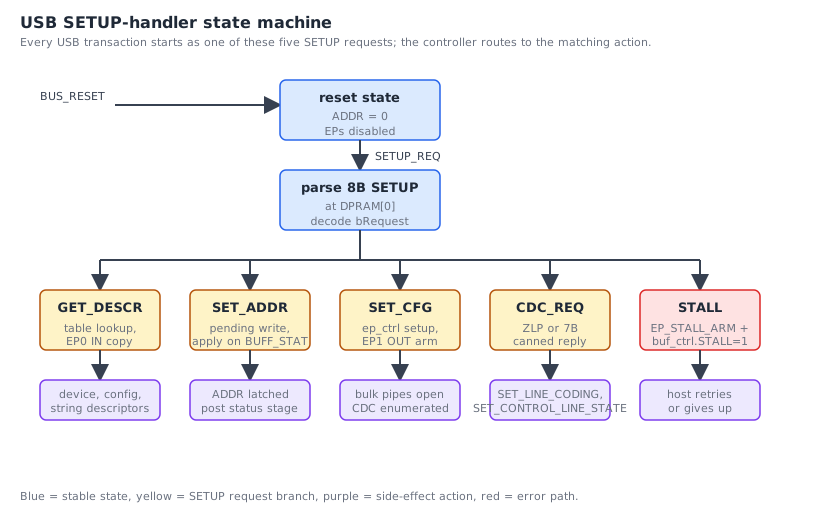
Key invariants:
- Toggle latency on SET_ADDRESS. USB spec says host issues
SET_ADDRESS(N)and the device must finish the status stage at address zero, then start usingN. We latchNintousb_pending_addressand the BUFF_STATUS handler applies it after the EP0 IN ZLP completes. - EP0 PID reset. A control transfer's first IN data packet always
uses DATA1. At each SETUP entry we reset
usb_ep0_pid = 1so the nextusb_ep_sendpicks DATA1 and toggles to DATA0 for the second packet. - Status-stage arming. After replying to
GET_DESCRIPTORwe re-arm EP0 OUT withlen = 0so the host's status ZLP is consumed.
CDC-ACM descriptor walkthrough
The host enumerates a CDC-ACM device by reading these descriptors in order:
-
Device descriptor (18 B): VID 0x2E8A, PID 0x10EE, class = MISC (0xEF / 02 / 01) so the IAD subclass kicks in and the host knows to look at the interface descriptors for the actual class.
-
Configuration descriptor bundle (67 B): header + interface + CDC functional descriptors + endpoints. Two interfaces:
iface class subclass endpoint purpose 0 CDC (0x02) ACM (2) EP2 IN int notifications (unused) 1 CDC-DATA - EP1 IN/OUT bulk data (host <-> dev) The CDC functional descriptors (header / call-mgmt / ACM / union) sit after interface 0 and before its endpoint descriptor. Their order matters:
lsusb -vrejects bundles that reorder them. -
String descriptors: language id 0x0409, manufacturer "ticktrace", product "ticktrace CDC", serial "000000000001".
After the host issues SET_CONFIGURATION 1 the firmware:
- Writes ep_ctrl[1].in / ep_ctrl[1].out / ep_ctrl[2].in to enable the bulk and interrupt endpoints.
- Arms EP1 OUT for a 64-byte transfer (so the first host-typed byte can land).
- Replies with a ZLP on EP0 IN (status stage of
SET_CONFIGURATION).
/dev/ttyACM0 appears on the host once steady-state enumeration finishes.
Cycle budgets (real silicon, 150 MHz clk_sys)
| function | cycles |
|---|---|
usb_device_init |
~80 + reset settle |
usb_ep_send small payload (N bytes) |
~30 + 4N |
usb_ep_receive_arm |
~14 |
| ISR fast path (BUFF_STATUS, EP1 OUT drain) | ~60 |
| ISR SETUP path (GET_DESCRIPTOR Device) | ~80 |
| ISR SETUP path (SET_ADDRESS) | ~30 |
cdc_putc ring push (no flush) |
~20 |
What to test on a real Pico 2
-
Build and flash. Either variant works on hardware now (see
docs/boot.md); the flash variant is recommended for anything you want to survive a power cycle:make build/usb_cdc_echo_demo_flash.uf2 # hold BOOTSEL while plugging in USB cp build/usb_cdc_echo_demo_flash.uf2 /run/media/$USER/RP2350/ -
Within ~1 s,
dmesgon a Linux host should show:usb 1-1.4: new full-speed USB device number 12 using xhci_hcd usb 1-1.4: New USB device found, idVendor=2e8a, idProduct=10ee usb 1-1.4: Product: ticktrace CDC usb 1-1.4: Manufacturer: ticktrace cdc_acm 1-1.4:1.0: ttyACM0: USB ACM device -
Open the port and exercise the echo:
stty -F /dev/ttyACM0 raw -echo
cat /dev/ttyACM0 &
echo "hello, ticktrace!" > /dev/ttyACM0
Expect "hello, ticktrace!" to print on the terminal.
Fallback: descriptor-only
If the CDC echo path is misbehaving, flash usb_descriptor_only_demo_flash.uf2
instead. It runs the same usb_device_init and SETUP plumbing -- so it
also enumerates as a CDC device and ttyACM0 will appear -- but its
main loop is just wfi. No bytes flow on EP1, so reads/writes against
/dev/ttyACM0 will time out without echoing.
This separates "is enumeration alive?" (descriptor-only enumerates => controller + PHY + SETUP + bulk-EP descriptors are all correct) from "is the bulk data path working?" (only the CDC echo demo actually exercises EP1 OUT/IN traffic).
What's supported
- Device mode, full-speed (12 Mbps).
- EP0 control transfers, including multi-packet IN for descriptors
larger than the 64-byte EP0 max packet size. The CDC config bundle
is 67 bytes;
_usb_ep0_start_txsaves state inusb_ep0_tx_{src, remaining}and ships chunks on each EP0 IN BUFF_STATUS until the whole transfer is delivered. - Independent EP0 IN/OUT PID toggles (
usb_ep0_pid/usb_ep0_out_pid). - EP1 bulk IN + OUT, EP2 interrupt IN, all with
INTERRUPT_PER_BUFFset so buffer completions raise the USB IRQ. - CDC-ACM class on EP1 (data) + EP2 (notification).
What's deliberately NOT supported in v0.1
- Host mode (only device).
- Isochronous endpoints.
- Multiple configurations or alternate settings.
- Remote wake / suspend / LPM.
- Double-buffered endpoints.
- CDC AT commands (we report
bInterfaceProtocol = 0). - Real
SET_LINE_CODINGhonouring (we ack and discard). - ZLP-after-MPS-multiple at end of IN transfer (our descriptors aren't multiples of 64, so the short final packet implicitly terminates).
Everything above is reachable from the same controller registers; the
v0.2 milestone is a good place to add isoc audio or a HID composite
device, both of which reuse usb_ep_send / usb_ep_receive_arm.