SPI (PL022) controllers
This document covers the RP2350 SPI driver in src/spi.S and the three
end-to-end demos in examples/spi_*.S.
Datasheet refs:
- RP2350 datasheet rev 0.3 (Aug 2024) section 12.3.
- ARM PrimeCell SSP TRM (DDI 0194H) - canonical PL022 register map.
Block at a glance
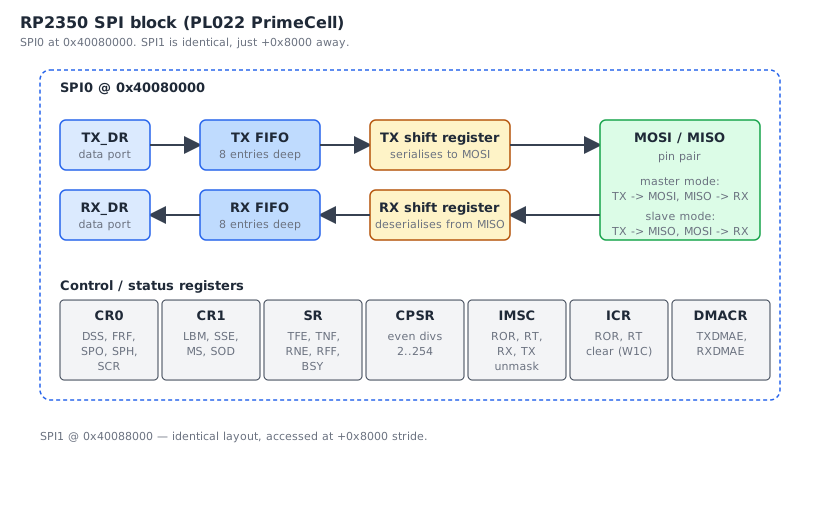
Register map (relative to SPIn_BASE)
  +0x00  SSPCR0    DSS[3:0] FRF[5:4] SPO[6] SPH[7] SCR[15:8]
  +0x04  SSPCR1    LBM[0] SSE[1] MS[2] SOD[3]
  +0x08  SSPDR     16-bit data port (write -> TX FIFO; read -> RX FIFO)
  +0x0C  SSPSR     TFE[0] TNF[1] RNE[2] RFF[3] BSY[4]
  +0x10  SSPCPSR   CPSDVSR[7:0]  (even number, 2..254)
  +0x14  SSPIMSC   RORIM[0] RTIM[1] RXIM[2] TXIM[3]
  +0x18  SSPRIS    raw IRQ status
  +0x1C  SSPMIS    masked IRQ status (= RIS & IMSC)
  +0x20  SSPICR    W1C: bits 0/1 only (RORIC/RTIC)
  +0x24  SSPDMACR  RXDMAE[0] TXDMAE[1]
The standard atomic alias windows apply: +0x1000 XOR, +0x2000 SET,
+0x3000 CLR. The driver uses RMW for CR1 mutations rather than the
SET/CLR aliases because the SSE-on-CR0-stable invariant requires a
specific sequence.
CPOL / CPHA matrix
| CPOL (SPO) | CPHA (SPH) | Sampled | Idle SCK | Notes |
|---|---|---|---|---|
| 0 | 0 | rising | low | "Mode 0" - default |
| 0 | 1 | falling | low | "Mode 1" |
| 1 | 0 | falling | high | "Mode 2" |
| 1 | 1 | rising | high | "Mode 3" |
Frame format (SSPCR0 bits [5:4]) selects the protocol on top of CPOL/CPHA:
| FRF | Protocol | DSS supported |
|---|---|---|
| 0 | Motorola SPI | 4..16 bits |
| 1 | TI synchronous SSF | 4..16 bits |
| 2 | National Microwire | 8 bits only |
Baud math
effective_clock = clk_peri / (CPSDVSR * (1 + SCR))
with clk_peri = 150 MHz post-M2. CPSDVSR is even, 2..254. SCR is
0..255. spi_set_baudrate walks CPSDVSR upward, computing the smallest
prescale that satisfies (prescale + 2) * 256 * baud > clk_peri, then
solves SCR = round(clk_peri / (prescale * baud)) - 1. The 64-bit
UMULL guard avoids 32-bit overflow at very high baud (>16 MHz).
Achieved baud table on a 150 MHz clk_peri:
| Requested | CPSDVSR | SCR | Achieved | Error |
|---|---|---|---|---|
| 1 MHz | 2 | 74 | 1 000 000 Hz | 0% |
| 4 MHz | 2 | 18 | 3 947 368 Hz | -1.32% |
| 25 MHz | 2 | 2 | 25 000 000 Hz | 0% |
| 75 MHz max | 2 | 0 | 75 000 000 Hz | 0% |
SPI master Fmax on PL022 is clk_peri / 2; slave Fmax is clk_peri / 12.
SSPFSSOUT vs SIO CS
PL022's FSSOUT line drops low for exactly one frame before rising
again. That's incompatible with most SPI peripherals which expect CS to
stay low across an entire multi-byte transaction.
Our policy:
spi_set_pins(idx, sck, mosi, miso, cs)configures sck/mosi/miso via FUNCSEL=GPIO_FUNC_SPI and treats cs as a regular SIO output that the application drives.spi_cs_low(cs_pin)/spi_cs_high(cs_pin)thinly wrapgpio_putfor ergonomic call-site bracketing.- Real CS bracketing - drive low, transfer, drive high - is the application's responsibility.
If your slave does want per-frame FSS pulses (rare), pass cs = -1 to
spi_set_pins to skip CS init and gpio_set_function(cs_pin, GPIO_FUNC_SPI) it yourself.
Driver API quick reference
| Symbol | Purpose |
|---|---|
spi_init(idx, baud_hz) |
Reset clear + 8-bit Motorola defaults + baud + SSE on |
spi_deinit(idx) |
SSE off + reset assert |
spi_set_baudrate(idx, baud_hz) -> r0 |
Reprogram CPSDVSR + SCR; returns achieved baud |
spi_set_format(idx, bits, cpol, cpha, frf) |
Rebuild CR0 keeping SCR |
spi_set_slave(idx, on) |
CR1.MS bit |
spi_set_loopback(idx, on) |
CR1.LBM bit |
spi_set_pins(idx, sck, mosi, miso, cs) |
gpio FUNCSEL on sck/mosi/miso; SIO out on cs |
spi_write_blocking(idx, src, len) -> r0 |
Push len bytes; discard RX |
spi_read_blocking(idx, repeated_tx, dst, len) -> r0 |
Clock dummy bytes; collect RX |
spi_write_read_blocking(idx, src, dst, len) -> r0 |
Full duplex |
spi_is_writable(idx) -> r0 |
TNF |
spi_is_readable(idx) -> r0 |
RNE |
spi_is_busy(idx) -> r0 |
BSY |
spi_set_irqs_enabled(idx, mask) |
SSPIMSC |
spi_clear_irq(idx, mask) |
SSPICR (W1C; bits 0/1 only) |
spi_set_dma_enabled(idx, tx_on, rx_on) |
SSPDMACR |
spi_cs_low(cs_pin) / spi_cs_high(cs_pin) |
gpio_put wrappers |
Cycle budgets (Cortex-M33 @ 150 MHz, no wait states)
| Symbol | Cycles |
|---|---|
spi_is_writable / readable / busy |
4 (base + ldr SSPSR + lsr + and) |
spi_write_blocking inner step |
~6 per byte once TNF asserts |
spi_set_baudrate |
~30 (one UDIV + couple of comparisons) |
spi_init |
~40 + reset settle |
DMA chained-channel pattern
Two channels concurrently driving an SPI burst:
  ch0 (TX): READ_ADDR=src,    WRITE_ADDR=SSPDR (fixed),
            INCR_READ, paced by DREQ_SPI<n>_TX, count = N
  ch1 (RX): READ_ADDR=SSPDR (fixed), WRITE_ADDR=dst,
            INCR_WRITE, paced by DREQ_SPI<n>_RX, count = N
Wire it up as in examples/spi_dma_demo.S:
spi_init(0, 1_000_000);
spi_set_loopback(0, 1);          // for self-test; remove for real link
spi_set_dma_enabled(0, /*tx*/1, /*rx*/1);

dma_init();
// Configure RX channel FIRST so it's armed before TX clocks start.
dma_channel_configure(/*ch=1*/, ctrl_rx, SPI0_BASE+SSPDR, dst, N, /*trig*/1);
// Then TX - this kicks the actual data movement.
dma_channel_configure(/*ch=0*/, ctrl_tx, src, SPI0_BASE+SSPDR, N, /*trig*/1);
DREQ codes (cross-checked against include/dma.inc TREQ table):
| Source | Code |
|---|---|
| SPI0 TX | 24 |
| SPI0 RX | 25 |
| SPI1 TX | 26 |
| SPI1 RX | 27 |
Examples
| File | What it does |
|---|---|
examples/spi_loopback_demo.S |
SPI0 internal LBM, 256-byte ramp self-test |
examples/spi_dma_demo.S |
SPI0 LBM + 2-channel DMA, 1 KiB pipe |
examples/spi_master_slave_loopback_demo.S |
SPI0 master <-> SPI1 slave with jumpers |
The loopback demos run at the bootrom-default 12 MHz clk_peri to keep
the UF2s small; real silicon at 150 MHz clk_peri would clock 12.5x
faster but the register write trace is identical.
TODO (deffered)
- No PLL bring-up in the demos. At 12 MHz
clk_peri, the achieved baud at "1 MHz" is 12 MHz / (2 * 75) = 80 kHz. This is fine for loopback and for proving the register sequence; real-link work needs the clocks demo's PLL bring-up first. - No FIFO threshold IRQs in the demos. RXIM/TXIM are exposed in
spi_set_irqs_enabledbut no example wiresNVICto handle them. - Slave mode CS is a single byte. PL022 in slave mode treats each rising FSS edge as end-of-frame and re-arms. The master/slave demo sidesteps this by pre-loading the slave TX FIFO before the master starts clocking.