TIMER0 / TIMER1 / SysTick
This document covers the RP2350 wall-clock timers and the Cortex-M33
SysTick reload counter, as implemented by src/timer.S, src/systick.S,
and the NVIC helpers in src/nvic.S.
Block layout
SysTick (Cortex-M33 SCS)             0xE000E010..0xE000E01C
  CSR  ENABLE / TICKINT / CLKSOURCE
  RVR  reload value (24 bits)
  CVR  current value (24 bits)
  CALIB calibration (RO)

  -> SysTick exception (vector index 15)
64-bit read protocol
The TIMER0/TIMER1 counters are 64-bit, but the AHB is 32 bits wide. To get a coherent snapshot, the hardware exposes a read latch:
| Offset | Name | Behaviour |
|---|---|---|
| 0x0c | TIMELR |
Reads the low half and latches the high half to TIMEHR. |
| 0x08 | TIMEHR |
Reads the latched high half (must be read AFTER TIMELR). |
| 0x28 | TIMERAWL |
Unsynchronised low half (no latch). |
| 0x24 | TIMERAWH |
Unsynchronised high half (no latch). |
time_us_64 follows the latch protocol; time_us_32 uses TIMERAWL since
a 32-bit-only read can't tear.
time_us_64:                        @ ~7 cycles
    ldr     r2, =TIMER0_BASE
    ldr     r0, [r2, #0x0c]        @ TIMELR (latches HI)
    ldr     r1, [r2, #0x08]        @ TIMEHR
    bx      lr
If you read TIMEHR first, you'll see a stale snapshot when the low half wraps between the two reads (~71 minutes apart, but if you happen to land on it, your timestamp jumps forward by 2^32 us).
Alarm compare-low-only quirk
ALARMn registers are 32 bits, and they compare against TIMELR (the low half only). This means:
- The maximum lookahead per re-arm is 2^32 us = 71 minutes.
- For longer waits the caller (or ISR) must rearm
n_remaining_uslater by reading time_us_64 and re-issuing alarm_set. - Writing ALARMn auto-arms the corresponding ARMED bit. To disarm, write 1 to that bit in ARMED (RW1C semantics).
- The IRQ flag (INTR) is W1C - clear it in the ISR before leaving.
alarm_set(timer_idx=0, alarm_idx=2, target_lo=0xDEADBEEF, target_hi=0)
    -> TIMER0_BASE + 0x18 = 0xDEADBEEF      (auto-arms ARMED.bit2)
    -> TIMER0_BASE + 0x34 = (1<<2)          (W1C any prior INTR.bit2)
NVIC line table
| Line | Name | Source |
|---|---|---|
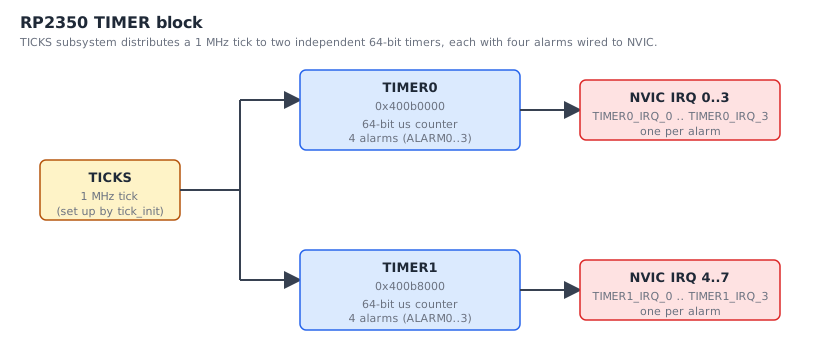
| 0 | TIMER0_IRQ_0 | TIMER0 ALARM0 |
| 1 | TIMER0_IRQ_1 | TIMER0 ALARM1 |
| 2 | TIMER0_IRQ_2 | TIMER0 ALARM2 |
| 3 | TIMER0_IRQ_3 | TIMER0 ALARM3 |
| 4 | TIMER1_IRQ_0 | TIMER1 ALARM0 |
| 5 | TIMER1_IRQ_1 | TIMER1 ALARM1 |
| 6 | TIMER1_IRQ_2 | TIMER1 ALARM2 |
| 7 | TIMER1_IRQ_3 | TIMER1 ALARM3 |
Vector-table location: the _vectors table from src/startup.S lives at
the start of SRAM (0x20000000) and is writable. nvic_install_handler
patches it directly via *VTOR + 0x40 + irq_num*4; no copy is required.
nvic_install_handler(irq_num, handler):
    *(*(SCB_VTOR) + 0x40 + irq_num*4) = handler | 1
The Thumb bit is OR'd in unconditionally so callers can pass either
&handler or &handler + 1.
The two timer blocks must be brought out of reset before use. M2's
startup did not touch RESETS bits 23 (timer0) or 24 (timer1); call
timer_init (alias for timer_resets_enable) once at boot. The 1 MHz
TICK input was already wired up by M2's tick_init.
SysTick at 150 MHz cookbook
SysTick's reload register is 24 bits, so at the post-M2 clk_sys=150 MHz
the maximum period is 2^24 / 150e6 = 111.85 ms. For longer ticks set
CSR.CLKSOURCE=0 to use the divided source (clk_sys/8 = 18.75 MHz);
maximum period then becomes ~895 ms.
| Period | RVR (CSR.CLKSOURCE=1, processor clock) |
|---|---|
| 1 ms | 150_000 - 1 |
| 5 ms | 750_000 - 1 |
| 10 ms | 1_500_000 - 1 |
| 100 ms | 15_000_000 - 1 (close to the 24-bit limit) |
systick_start_periodic(150_000 - 1):    @ 1 ms tick
    SYST_CSR = 0
    SYST_RVR = 149_999
    SYST_CVR = 0                        @ any write clears
    SYST_CSR = ENABLE | TICKINT | CLKSOURCE
The handler must live at vector index 15 (SysTick is a system exception,
not an external IRQ, so nvic_install_handler does not apply - see
examples/systick_demo.S for the direct-VTOR-patch idiom).
Cycle budgets (Cortex-M33, no wait states)
| Function | Cycles | Notes |
|---|---|---|
time_us_32 |
~3 | 1 ldr + bx |
time_us_64 |
~7 | latch protocol + 2 ldrs |
delay_us(N) (small N) |
5/iter | tight ldr/sub/cmp/blo loop |
delay_ms(N) |
4 + delay_us(N*1000) cycles | |
alarm_set |
~10 | INTR W1C + ALARMn store |
alarm_cancel |
~6 | ARMED W1C |
alarm_clear_irq |
~6 | INTR W1C |
alarm_enable_irq |
~6 | INTE atomic SET |
systick_start_periodic |
~6 | 3 stores |
systick_stop |
~4 | 1 store |
systick_get_value |
~3 | 1 ldr |
nvic_enable_irq |
~6 | bitmask + indexed store |
nvic_set_priority |
~7 | 1 byte store |
nvic_install_handler |
~6 | VTOR read + indexed store |
Example: 100 ms alarm-driven blink
See examples/timer_alarm_demo.S. The full IRQ plumbing is:
1. timer_init                          @ release TIMER0/1 from reset
2. nvic_install_handler(0, alarm0_isr) @ patch vec[16]
3. alarm_enable_irq(0, 0)              @ INTE.ALARM0 = 1
4. nvic_enable_irq(0)                  @ NVIC line 0 unmask
5. alarm_set(0, 0, time_us_32() + 100_000, 0)
6. main: wfi forever; ISR re-arms.
Datasheet notes / open questions
- Datasheet rev 0.3 (Aug 2024) sec 12.8 documents the TIMER block; RESETS bit positions for timer0/timer1 are 23/24 per sec 7.5.
- The "compare on low 32 bits only" behavior is mentioned in passing in
sec 12.8.3. The
ALARMxtext is not explicit that the comparator is 32-bit-only - we infer it from the register width and the fact there's no separate ALARMxH register. - NVIC line numbers 0..7 for the eight timer alarms are listed in sec 3.2 of rev 0.3 (Table 3.1); this matches what we use here.