Studio
A complementary product to the ticktrace SDK that lets users pick a target, toggle
peripherals, build, and flash without touching make or picotool. Studio
lives in studio/ as its own Go module and consumes the parent SDK by relative
paths: modules in the catalog point at ../src/foo.S, linker scripts at
../link/*.ld. Nothing about Studio adds source code Studio doesn't already
consume; it is the build system from the user's perspective.
The CLI (rpasm) and GUI (rpasm-studio) share every internal package; the
two binaries differ only in their main file and the GUI's view layer. A
build that succeeds in one always succeeds the same way in the other.
Project file (*.rpasm.toml)
Top-level fields:
| Field | Type | Required | Notes |
|---|---|---|---|
name |
string | yes | Identifier; drives output filenames (<name>.uf2) |
target |
string | yes | Must match a catalog target (rp2350-arm in v1) |
layout |
string | no | "flash" (default) or "sram" |
rpasm_version |
string | yes | Currently "1.0" |
studio_mode |
string | no | GUI hint: "examples" or "custom". Inferred from contents. |
example_name |
string | no | GUI Examples-mode bookkeeping |
Subtables:
[features]
UART = true
PIO  = false                   # explicitly override a catalog default

[user_source]
files = ["../src/main.S"]      # paths relative to SDK root

[bootloader]
tsbl = "ab"                    # "bypass" or "ab"; see docs/bootloader.md
[features] is a map of catalog symbol → bool. A true enables a module;
a false overrides a catalog default-on module off. Symbols not listed take
their catalog default. The GUI's "Selected modules" badges show the resolved
set.
[bootloader], when present, switches the build engine into chain mode:
the app links at slot A's base (0x10008000), SSBL and the chosen TSBL flavor
are assembled from the SDK, footers are computed, and the chain is packed into
firmware_<name>.uf2. [bootloader] requires layout = "flash".
Catalog (studio/catalog/)
Target TOML
catalog/targets/<name>.toml:
| Field | Type | Notes |
|---|---|---|
name |
string | Matches the project's target field |
arch |
string | "arm" (Hazard3 RISC-V deferred to v1.1) |
toolchain_prefix |
string | e.g. "arm-none-eabi-" |
as_flags |
[]string | Pass-through to as |
as_includes |
[]string | Each becomes -I <path> |
ld_flags |
[]string | Pass-through to ld |
ld_script_flash |
string | Linker for layout = "flash" |
ld_script_sram |
string | Linker for layout = "sram" |
flash_load_addr |
u32 | UF2 block base when layout=flash |
sram_load_addr |
u32 | UF2 block base when layout=sram |
uf2_family_id |
u32 | Default family ID; UF2 family is also auto-picked by load address (0xE48BFF57 for SRAM-range addresses) |
Module TOML
catalog/{system,peripherals}/<name>.toml:
| Field | Type | Notes |
|---|---|---|
symbol |
string | Stable identifier referenced from [features] |
name |
string | Human label for the GUI checkbox |
category |
string | "system" or "peripherals" |
order |
int | Link-time ordering; ties broken by symbol |
default |
bool | Enabled when no [features] entry overrides it |
description |
string | Shown as hover/help in the GUI (planned) |
sources |
[]string | .S files included when the module is enabled |
requires |
[]string | Other symbols that must also be enabled |
Path conventions: sources use relative paths from the SDK root
(../src/uart.S). The build engine's working directory is the SDK root, so
.include "src/uart.S" directives inside an .S file resolve naturally.
Build pipeline
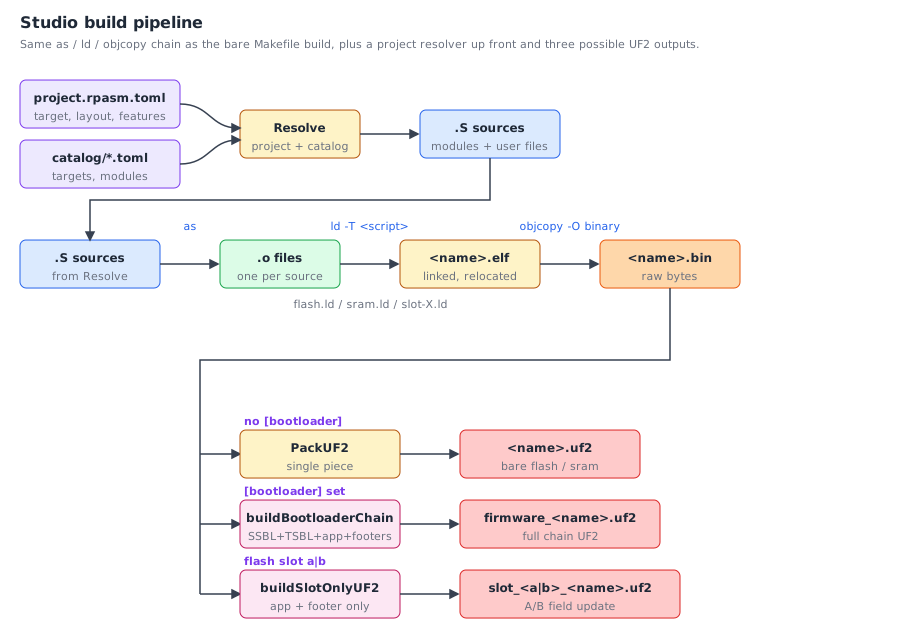
Slot-only mode
build.Options.Slot = "a" | "b" (CLI --slot a|b) builds just the app at
that slot's base and packs only app + app-footer:
| Slot | Linker script | App base | Footer addr | Default seq |
|---|---|---|---|---|
| A | link/app_at_0x10008000.ld |
0x10008000 |
0x1007FF00 |
1 |
| B | link/app_at_0x10080000.ld |
0x10080000 |
0x100F7F00 |
2 |
Output filename: slot_<a|b>_<name>.uf2. SSBL/TSBL are not rebuilt or written;
the existing on-chip bootloader chain selects between A and B by sequence.
Output files
A bootloader project produces, in studio/build/<name>/:
| File | Contents |
|---|---|
<name>.elf, .bin, .map |
App build at slot A's base |
firmware_<name>.uf2 |
Full chain: SSBL + TSBL + footers + app + footer |
slot_a_<name>.uf2 |
Slot-A-only (after --slot a) |
slot_b_<name>.uf2 |
Slot-B-only (after --slot b) |
_ssbl/, _tsbl_<flavor>/ |
Per-stage intermediates (object, ELF, bin, map) |
Non-bootloader projects produce just <name>.{elf,bin,map,uf2}.
Flash pipeline
rpasmboot
This is our take on the RP2040 PICOBOOT protocol, adapted for ticktrace.
The in-tree client (studio/internal/rpasmboot) speaks the RP2350 PICOBOOT
wire protocol directly over usbfs on Linux. No external picotool or
libusb dependency.
| Command | ID | Used for |
|---|---|---|
EXCLUSIVE_ACCESS |
0x01 | Lock the USB MSC interface (eject the drive) |
FLASH_ERASE |
0x03 | Sector-aligned erase |
WRITE |
0x05 | Page-aligned write (flash or SRAM) |
EXIT_XIP |
0x06 | Required before any flash read/write |
READ |
0x84 | Read flash/SRAM (IN direction) |
REBOOT2 |
0x0a | Reboot into Normal / RAM_IMAGE / BOOTSEL |
GET_INFO |
0x8b | Chip info |
Two gotchas worth noting (see MEMORY.md → PICOBOOT protocol gotchas):
- PICOBOOT interface on shipped silicon has
bInterfaceProtocol=0x00, not0x01asRESET_INTERFACE_PROTOCOLin the SDK header suggests. The enumerator filters onbInterfaceClass=0xffonly. - Control transfers (
IF_RESET,IF_CMD_STATUS) usebmRequestTypeof vendor type (0x41/0xc1), not class (0x21/0xa1).
Method selection
flash.Options.Prefer:
| Value | Behavior |
|---|---|
"" (auto) |
rpasmboot first; on failure, fall back to drive copy |
rpasmboot |
Force rpasmboot |
drive |
Force drive copy (write the UF2 onto the mounted RPI-RP2 / RP2350 drive) |
CLI: rpasm flash --method rpasmboot|drive|auto.
Orchestrator phases (rpasmboot path)
usbx.Openfinds the BOOTSEL device.IF_RESETclears any stale stalled state from a prior session.EXCLUSIVE_ACCESS(with EJECT) takes ownership and unmounts the MSC drive.EXIT_XIPif any flash range is present.- For each flash range: erase widened to sector boundaries, then write in
4 KiB chunks (page-aligned, padded with
0xFF). - For each SRAM range: direct write, no erase, no alignment requirement.
REBOOT2:Normalif any flash range was written.RAM_IMAGE(base = lowest SRAM addr, size = span) if SRAM-only.
A transport error on the REBOOT2 ACK is expected and logged at info; the
device disappears mid-transfer.
CLI reference (rpasm)
rpasm validate [--root DIR] <project.toml>
rpasm build    [--root DIR] [--out DIR] [-v] [--slot a|b] <project.toml>
rpasm flash    [--method rpasmboot|drive] [--slot a|b]
               (--uf2 <path> | [--root DIR] <project.toml>)
rpasm reboot   [--bootsel]
rpasm info
rpasm bootinfo
rpasm doctor   [--root DIR]
| Subcommand | Purpose |
|---|---|
validate |
Load project + catalog, print resolved modules and source list |
build |
Produce the UF2 (or firmware UF2) |
flash |
Write a UF2 to a BOOTSEL'd board |
reboot |
REBOOT2 the device (--bootsel enters BOOTSEL instead of Normal) |
info |
Enumerate BOOTSEL devices over USB (VID/PID/serial) |
bootinfo |
Read both slot footers from a BOOTSEL'd board (status/seq/CRC) |
doctor |
Toolchain detection + udev rule status + board status |
GUI map (rpasm-studio)
┌─ Mode tab bar:   Examples │ Custom Project ────────────┐
├─ Top bar:        Title │ Target │ Layout │ Build · Flash
├─ Tools row:      udev OK · Board status · Query slots
│                   └─ slot panel (after Query slots) ──
├─ Project row:    [path input] · Browse... · Save · Load
│
├─ Left pane:      Examples mode → example preview
│                  Custom mode  → Source input + selected
│                                 modules + Features grid
└─ Right pane:     Output │ Problems │ Memory ─────────
                   └ Memory tab: Regions · Bootloader
                                 chain · Sections
Modes
- Examples: Pick from
examples/*.S+ the canonicalsrc/main.Sblinky. Layout defaults tosram. No[features]UI; uses catalog defaults. - Custom Project: Pick
[features]+ a.Sfile path. Layout defaults toflash. Browse... + Load round-trips a.rpasm.toml(including[bootloader], silently carried through builds even though no widget toggles it yet).
Tools row
- udev: Linux only. Shows whether
/etc/udev/rules.d/99-rpasmboot.rulesis installed.rpasm doctorprints the one-linesudoinstall command. - Board: Polled every 2 s via
flash.DetectBoard(which scans/proc/mountsfor the RPI-RP2 / RP2350 drive label). - Query slots: Runs
flash.ReadBootInfoagainst the connected device. Renders a per-slot panel below the row.
Memory tab
Three sections, populated after each successful build:
- Regions:
ld --print-memory-usageoutput (FLASH / SRAM). - Bootloader chain (bootloader projects only): per-stage used/capacity
(SSBL, TSBL-
<flavor>, Slot A, Slot B) with base addresses. - Sections:
arm-none-eabi-size -Aoutput.
The same content is mirrored to stderr after each build (the GUI's a.log
helper writes to both the Output panel and the launching terminal).
Host setup
Linux USB access
PICOBOOT needs udev rule for non-root access. rpasm doctor checks
/etc/udev/rules.d/99-rpasmboot.rules; if missing, it prints the install
command. The rule body is:
SUBSYSTEM=="usb", ATTRS{idVendor}=="2e8a", MODE="0666", TAG+="uaccess"
MODE=0666 is the fallback; TAG+="uaccess" grants the logged-in user via
logind ACLs where present.
Toolchain
rpasm doctor checks for arm-none-eabi-{as,ld,objcopy,size} (prefix from
target TOML's toolchain_prefix). Missing tools fail at build time with a
diagnostic; the toolchain is not bundled with Studio.
Workspace
The repo uses a go.work file bridging studio/ and tools/ so Studio
imports tools/manifest + tools/firmware (the bootloader footer + chain
packers shared with the parent Makefile build). Building either module
from the workspace works; building outside it requires a replace
directive.
Cross-references
- Bootloader chain semantics, footer format, slot state machine, watchdog
scratch ABI:
docs/bootloader.md. - Parent SDK Makefile-driven build (alternative to Studio):
make build/<name>.uf2,make bootloader,make build/firmware_<name>.uf2. - Per-peripheral module references:
docs/{adc,uart,usb,pio,...}.md.