M4-E - UART (PL011)
This document covers the RP2350 UART driver in src/uart.S and the three
end-to-end demos in examples/uart_*.S.
Datasheet reference: RP2350 datasheet rev 0.3 (Aug 2024) section 12.1. Programmer's reference: ARM PrimeCell UART (PL011) Tech Ref. Manual r1p5 (DDI 0183G). The RP2350 implementation matches that revision verbatim plus the TX/RX DMA pacing extension exposed via the DMACR register.
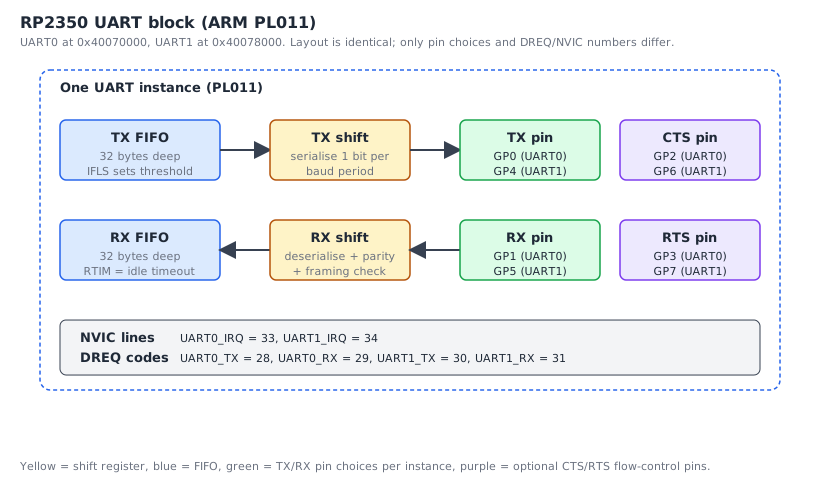
Block at a glance
Register cookbook
| Off | Reg | Notes |
|---|---|---|
| 0x00 | DR | Data. Write low 8 bits to TX; read low 8 bits from RX. |
| 0x04 | RSR | RX status / clear. Mostly mirrored in DR upper bits. |
| 0x18 | FR | Flag. TXFE/RXFE/TXFF/RXFF/BUSY/CTS. |
| 0x24 | IBRD | Integer baud divisor. 16-bit. |
| 0x28 | FBRD | Fractional baud divisor. 6-bit. |
| 0x2C | LCR_H | Line ctrl: WLEN, FEN, STP2, PEN/EPS, BRK, SPS. |
| 0x30 | CR | Master ctrl: UARTEN, TXE, RXE, LBE, RTSEN, CTSEN, SIREN, ... |
| 0x34 | IFLS | TX/RX FIFO interrupt level (1/8, 1/4, 1/2, 3/4, 7/8). |
| 0x38 | IMSC | Interrupt mask set/clear. RXIM, TXIM, RTIM, FEIM, ... |
| 0x3C | RIS | Raw interrupt status. |
| 0x40 | MIS | Masked (= RIS & IMSC) interrupt status. |
| 0x44 | ICR | W1C interrupt clear. |
| 0x48 | DMACR | DMA control: TXDMAE, RXDMAE, DMAONERR. |
Atomic register aliases (+0x1000 XOR / +0x2000 SET / +0x3000 CLR) apply.
Baud math
   divisor_q26 = clk_peri / (16 * baud)         (in Q26.6 fixed point: x64)
   IBRD        = floor(divisor_q26)
   FBRD        = round((divisor_q26 - IBRD) * 64)
   actual_baud = clk_peri / (16 * (IBRD + FBRD/64))
uart_set_baudrate and uart_init use the slightly simpler closed form
(clk_peri * 4) / baud, then split into IBRD = >> 6 and FBRD = & 0x3F,
which truncates rather than rounds the FBRD bit. The SDK and the datasheet
worked examples both truncate; the resulting baud error is < 0.1% at all
common rates we care about.
After writing IBRD/FBRD you MUST re-write LCR_H to commit the latch (PL011 quirk; see TRM section 3.3.6). All driver functions that touch IBRD/FBRD do this for you.
Pre-computed divisors (for reference)
| Clk | Baud | IBRD | FBRD | Actual | Error |
|---|---|---|---|---|---|
| 12 MHz | 115 200 | 6 | 33 | 115 108 | -0.08 % |
| 12 MHz | 230 400 | 3 | 16 | 230 769 | +0.16 % |
| 12 MHz | 460 800 | 1 | 40 | 462 692 | +0.41 % |
| 150 MHz | 115 200 | 81 | 24 | 115 211 | +0.01 % |
| 150 MHz | 230 400 | 40 | 44 | 230 415 | +0.01 % |
| 150 MHz | 460 800 | 20 | 22 | 460 829 | +0.01 % |
| 150 MHz | 921 600 | 10 | 11 | 921 658 | +0.01 % |
| 150 MHz | 1 000 000 | 9 | 24 | 1 000 000 | 0.00 % |
Public API
All functions take idx (0 or 1) where applicable and follow AAPCS
(args in r0..r3; r4..r11 callee-saved). Cycle counts measured on
Cortex-M33 from SRAM with no wait states.
| Function | Cycles | Notes |
|---|---|---|
uart_init(idx, baud, clk) |
~120 | RESETS + GPIO + IBRD/FBRD/LCR_H/CR |
uart_deinit(idx) |
~30 | CR=0; assert RESETS |
uart_set_baudrate(idx, baud, clk) |
~30 | UDIV-based; rewrites LCR_H to commit |
uart_set_format(idx, bits, stop, parity) |
~20 | Preserves FEN |
uart_set_hw_flow(idx, cts, rts) |
~14 | Preserves CR.UARTEN/TXE/RXE |
uart_set_irqs_enabled(idx, mask) |
4 | IMSC = mask |
uart_acknowledge_irq(idx, mask) |
4 | ICR = mask |
uart_set_dma_enabled(idx, tx, rx) |
~10 | DMACR = TXDMAE | RXDMAE |
uart_is_writable(idx) -> r0 |
4 | r0 = !(FR.TXFF) |
uart_is_readable(idx) -> r0 |
4 | r0 = !(FR.RXFE) |
uart_putc_blocking(idx, byte) |
~6+poll | spin while TXFF; str DR |
uart_puts_blocking(idx, str_ptr) |
~6/B+ | calls putc_blocking for each byte |
uart_getc_blocking(idx) -> r0 |
~6+poll | spin while RXFE; ldr DR |
uart_tx_wait_blocking(idx) |
poll | spin while FR.BUSY |
uart_set_irq_handler(idx, handler) |
~14 | nvic_install_handler + nvic_enable_irq |
v0.1 compatibility shims
uart0_init, uart0_putc, uart0_puts are preserved unchanged from v0.1.
uart0_init produces the EXACT same MMIO write sequence the v0.1 driver
did (PADS clears + IO_BANK0 funcsel + IBRD/FBRD/LCR_H/CR), so existing
trace tests (tests/unicorn/test_v01_blinky.py) continue to pass.
IRQ programming model
PL011 interrupts are aggregated into a single NVIC line per instance: UART0 -> IRQ 33, UART1 -> IRQ 34. Inside the ISR the firmware reads MIS to figure out which sources fired, services them, then writes those bits to ICR.
Recommended pattern for an RX-driven echo handler:
uart0_isr:
    push    {r4, lr}
    @ Service every byte currently sitting in the RX FIFO
.Lloop:
    movs    r0, #0
    bl      uart_is_readable
    cbz     r0, .Lack
    movs    r0, #0
    bl      uart_getc_blocking
    @ ... do something with r0 ...
    b       .Lloop
.Lack:
    @ Clear both RXIM (FIFO threshold) and RTIM (timeout) so a single
    @ typed character doesn't stall waiting for the IFLS threshold.
    movs    r0, #0
    movw    r1, #(UART_INT_RXIM | UART_INT_RTIM)
    bl      uart_acknowledge_irq
    pop     {r4, pc}
Setup at boot:
    movs    r0, #0
    ldr     r1, =uart0_isr
    bl      uart_set_irq_handler            @ patches vector + nvic enable
    movs    r0, #0
    movw    r1, #(UART_INT_RXIM | UART_INT_RTIM)
    bl      uart_set_irqs_enabled
The driver does NOT touch IFLS so the trigger threshold stays at the
PL011 reset default of 1/2 (UART_IFLS_LEVEL_1_2 << TXIFLSEL_LSB and
similarly for RX). Adjust by writing IFLS directly if you need finer
latency control.
DMA pacing setup
Both TX and RX FIFOs can be drained / filled by the DMA controller. The
PL011 raises DREQ_UART<n>_TX (codes 28, 30) when there is space in the
TX FIFO and DREQ_UART<n>_RX (codes 29, 31) when there is data in the
RX FIFO. Wire one DMA channel per direction.
Minimal TX pacing example (extracted from examples/uart_dma_demo.S):
    movs    r0, #0
    movs    r1, #1                          @ tx
    movs    r2, #0                          @ rx
    bl      uart_set_dma_enabled            @ DMACR.TXDMAE = 1

    ldr     r1, =(DMA_CTRL_EN | DMA_DATA_SIZE_BYTE | DMA_CTRL_INCR_READ \
                | (DREQ_UART0_TX << DMA_CTRL_TREQ_SEL_LSB))
    ldr     r0, =RAMP_LEN
    movs    r4, #1
    push    {r0, r4}                        @ count, trig
    movs    r0, #0                          @ ch
    ldr     r2, =ramp                       @ src
    ldr     r3, =UART0_BASE + UART_DR       @ dst (fixed)
    bl      dma_channel_configure
For RX you mirror the configuration: src = UART0_BASE + UART_DR (fixed,
no INCR_READ), dst = SRAM buffer (INCR_WRITE), TREQ = DREQ_UART0_RX.
If you want the DMA channel to halt automatically on a UART RX error
(framing, parity, break, overrun) set DMACR.DMAONERR = 1 in addition to
the RXDMAE bit; the PL011 then de-asserts RXDMAE on the next error and
the channel falls idle.
RTS/CTS hardware flow control
uart_set_hw_flow(idx, cts_en, rts_en) toggles CR.RTSEN and CR.CTSEN
without disturbing UARTEN/TXE/RXE/SIREN. You still need to route the
RTS/CTS pins to the UART function manually (the driver only configures
TX/RX during uart_init). Per the RP2350 SDK convention:
| UART | TX | RX | CTS | RTS |
|---|---|---|---|---|
| 0 | GP0 | GP1 | GP2 | GP3 |
| 1 | GP4 | GP5 | GP6 | GP7 |
Example wiring snippet:
    @ TX/RX done by uart_init.  Now route CTS/RTS pads to the UART function.
    movs    r0, #2                          @ CTS pin
    movs    r1, #GPIO_FUNC_UART
    bl      gpio_set_function
    movs    r0, #3                          @ RTS pin
    movs    r1, #GPIO_FUNC_UART
    bl      gpio_set_function

    @ Enable both directions of HW flow.
    movs    r0, #0
    movs    r1, #1                          @ cts_en
    movs    r2, #1                          @ rts_en
    bl      uart_set_hw_flow
The PL011 implements RTS as "we have RX FIFO room above the IFLS RX trigger level"; it auto-deasserts when the FIFO crosses 7/8 and re-asserts on a read that drops it below the IFLS threshold.
Examples
| File | What it does |
|---|---|
examples/uart_irq_demo.S |
UART0 RX IRQ echo + GP25 LED toggle per byte |
examples/uart_dma_demo.S |
DMA paced 256-byte ramp out of UART0 TX |
examples/uart_loopback_demo.S |
UART0 <-> UART1 ping/pong at 921 600 8N1 |
The loopback example expects the user to jumper TX0 -> RX1 and TX1 -> RX0
on a real board. Under Renode (tests/renode/uart.resc) we wire it via
the standard UARTHub connector mechanism so no jumper is required.
Testing
| Tier | Coverage |
|---|---|
| T1 | 29 unit tests in tests/unicorn/test_uart.py covering every public |
| entry point + the v0.1 trace contract + all 3 example UF2 builds. | |
| T2 | N/A. The PL011 model is generic enough to run on QEMU mps2-an505, |
| but the RP2350-specific base addresses won't match any QEMU machine. | |
| T3 | tests/renode/uart.resc runs uart_loopback_demo for 500 ms and |
| asserts both UARTs see their respective bytes. |